

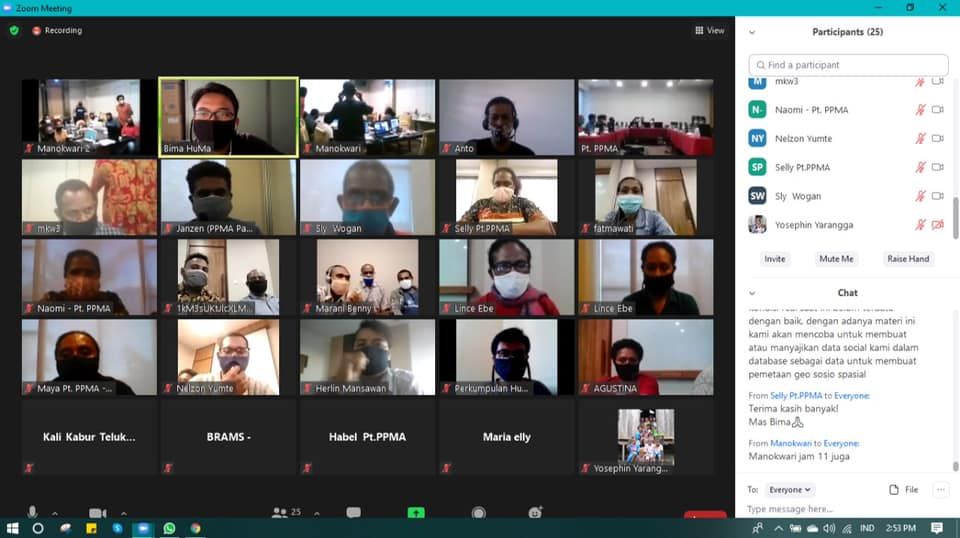
On November 27-31, 2020, the HuMa Indonesia Association held a Virtual Field School for Papua and West Papua, with the theme "Management and Presentation of Data to Prepare Planning for the Development of Indigenous Legal Communities and the Development of Their Customary Territories".
The Virtual Field School is one of HuMa's new innovations to combat the spread of the CoVid-19 virus. The activity was carried out with a combination of Online and Offline. Participants who attended included colleagues from Pt PPMA from Papua and Panah Papua, as well as several representatives of the community from West Papua. During the 5 days of the activity, the participants gathered together in Jayapura and Manokwari.
The Virtual Field School activity was guided by HuMa colleagues, namely Bimantara Adjie, Agung Wibowo and Nora Hidayati, and assisted by 2 (two) people as Host and Co-Host, namely Bramanta and Heru Kurniawan.
The description of the activities and materials studied together are as follows:
Day One (October 27, 2020).
The first day began with sharing knowledge and information regarding the common goals in organizing this Field School. This introduction at least provided an opportunity for all participants to get to know each other, and to determine the goals and achievements of this Field School training. In addition, the introduction process also became an opportunity to tell stories related to the situation and conditions of MHA and customary forest policies, both in Papua and West Papua.
The next topic, regarding the principles of Natural Resource Management and the Human Rights Perspective in the Recognition of MHA, was also an important part delivered by Agung Wibowo and Herlambang Wiratraman. They clearly explained the errors and haphazardness of legal regulations, which opened up the way for exploitation in Papua and West Papua. This indirectly contradicts the ideals of the 1945 Constitution of the Republic of Indonesia.
Information and knowledge related to this theoretical introduction will later have implications for increasing the critical power of Field School participants, and will be the starting point in continuing several agendas on the following day. Conceptual alignment in this case is important, as the main collaborative step in the Advocacy Plan for the Recognition of MHA, Customary Areas and Customary Forests.
2. Second Day (October 28, 2020).
After struggling with the basic perception of common knowledge about natural resource management, on the second day participants learned about the process of organizing communities, followed by how to build cooperation and collaboration with the Village Government (Villages in Papua and West Papua).
The Community Organization material guided by Noer Fauzi Rachman, clearly emphasized that the concept of mentoring and learning in the community is currently increasingly minimal, because many institutions are too focused on policy advocacy issues. In fact, the facts show that intensive mentoring is necessary and important, as a way to maintain communication with the community. In addition, emotional closeness also needs to be built in the community, as a basis for activities to organize the community.
Next, Andik Hardiyanto brought up the issue related to the importance of collaboration between Village Communities, Village Governments, and Civil Society as the key. Why is this important? Because sometimes the Village Government is hesitant or has not been able to sensitively read the situation and conditions of the community. Therefore, this Field School is a bridge between the three parties above, as part of the preparation of joint work steps based on Geosociospatial Data. From the results of this joint work, it will be shown how to optimize the Village Fund/Village Fund budget, according to its designation and benefit the community.
Before ending the meeting on the second day, as part of following up on the organizational model and building collaborative work with the parties, especially the Village Government, it was proposed to introduce how to create and build a joint work system, with a digital data approach in the form of Geosociospatial Data.
Geosociospatial Data contains multi-design data, which if we use it does not only lead to social data, but also spatial data, and 3-dimensional data that can show specific conditions, conditions, and current situations of the community, which are produced based on community participation in data collection, collection and processing.
3. Third Day (October 29, 2020).
After getting to know the concept and seeing the results of the data collection directly in the field, the third day of training went into how to compile a format for conducting data collection, collection, and management.
On this day, participants were invited to participate in adjusting the format andta in the field context in Papua. In addition, participants were also invited to share approaches related to data collection, which will later be processed into Geosociospatial Data using the census method. This census method is interesting, because in the census process, it is expected that data based on facts and reality can be poured into one valid and accountable data.
In addition to the process explained above, the practice of introducing data management using various applications, both social data processing with Microsoft Excel and Microsoft Access, spatial data management with Quantum GIS and Global Mapper, and data merging, which can later produce one book, namely the Community Geosociospatial Data Book using the In-Design Application. This form of management is not only carried out directly by the facilitator, namely Asfriyanto, but is also guided by several fairly complete short learning videos, which are available on the hard disk distributed to Field School participants.
4. Fourth Day (October 30, 2020).
The learning process about Geosociospatial carried out in one day has a fairly good impact. Participants can now begin the process of processing social data, especially in optimizing the use of Microsoft Excel. This is important, considering that sensitivity and ability to maximize technology are the main components in the preparation and management of Geosociospatial Data.
After the evaluation of the learning process on Geosociospatial Data yesterday, participants were invited to understand and deepen the data needs that will be used, as an entry point for policy advocacy, especially customary area and customary forest policies. Customary forests owned by the community must be documented in the form of data, which is adjusted to applicable laws and regulations. In this case, Mega Dwi provided an explanation and guided participants directly, to optimize data and fill in the complete data needs for advocacy. The data filling processes based on laws and regulations have also been recorded, and made to be easier to understand and can be used directly by Virtual Field School participants in Papua and West Papua.
5. Day Five (October 31, 2020).
On the last day, participants were introduced to the integrated data system owned by HuMa, namely the customary area and forest monitoring system. Participants are allowed to open access to monitoring.huma.or.id. The system provides guarantees and warranties of data that can be integrated, as part of increasing ease of access for the community and assistants, in collecting data. This is also facilitated by easy-to-understand access and features. Participants only need to register an email as part of the steps in the data pooling process.
After 5 days of joint learning, HuMa and the participants followed up and updated the results of the implementation of the Follow-up Plan (RTL) for this Virtual Field School activity in the evaluation forum, after one week of trying to formulate the results of the implementation of the Field School.